In this article+
- 01What Determines Ecommerce Website Development Costs?
- 021. Product Catalogue Size and Complexity
- 032. Store Design and Shopping Experience
- 043. Arabic and English Content
- 054. Payment Gateway Requirements
- 065. Shipping and Delivery
- 076. Business System Integrations
- 08Shopify vs WooCommerce vs Custom Ecommerce Development
- 09When Shopify May Be a Good Fit
- 10When WooCommerce May Be a Good Fit
- 11When Custom Development Makes Sense
- 12What Should an Ecommerce Website Quotation Include?
- 13Example: Building a Budget for a UAE Online Store
- 14One-Time Costs vs Ongoing Ecommerce Expenses
- 15Ecommerce Business Requirements in the UAE
- 16How to Control Ecommerce Development Costs
- 17How to Compare Ecommerce Development Proposals
- 18How Does SEO Affect Ecommerce Development Cost?
- 19Conclusion: Plan the Whole Ecommerce Investment
# Ecommerce Website Cost in the UAE: A Complete Guide to Development and Ongoing Expenses
If you are planning to sell online in the United Arab Emirates, one of your first questions will probably be how much it costs to build an ecommerce website.
The initial quotation is only part of the answer. A functioning online store may also require product data preparation, payment processing, shipping configuration, bilingual content, ongoing maintenance, and customer support tools.
A small business launching a limited product catalogue has different requirements from a distributor managing thousands of products, wholesale pricing, multiple warehouses, and cross-border deliveries.
Understanding these differences is the best starting point for estimating ecommerce website costs in the UAE.
This guide explains the main cost drivers, compares common development approaches, and outlines what your quotation should include before you commit to a project.
What Determines Ecommerce Website Development Costs?
1. Product Catalogue Size and Complexity
Product count is important, but the amount of work depends on the structure and quality of the catalogue.
A store with 40 simple products may be relatively straightforward to configure. A store with 4,000 products, multiple variations, pricing rules, and stock locations may require a more advanced setup.
Product data also matters. Importing clean information from a structured file is different from writing descriptions, editing images, and entering products manually.
Before requesting a quotation, define the expected launch catalogue, product variations, and how inventory will be managed.
2. Store Design and Shopping Experience
An online store should make it easy to discover products, compare options, understand delivery terms, and complete purchases.
A carefully configured theme may suit an early-stage business. An established brand might require custom product pages, specialized filters, or a unique checkout experience.
The best investment is not necessarily the most visually elaborate design. It is a shopping experience that works clearly and reliably, especially on mobile devices.
3. Arabic and English Content
An ecommerce business operating in the UAE may need Arabic and English interfaces.
Bilingual development involves more than translating the homepage. It can affect product descriptions, categories, navigation, cart messages, checkout instructions, and customer communications.
Arabic layouts also require right-to-left support.
Your quotation should clarify whether content translation, editorial review, and bilingual product entry are included.
4. Payment Gateway Requirements
Online payments introduce technical and commercial requirements.
The store may need payment gateway integration, cash-on-delivery handling, or other payment methods appropriate to the business.
Provider fees can depend on the merchant's agreement, activity, services, and transaction types. Setup charges, transaction fees, refunds, and recurring charges should be verified directly with the provider.
Gateway account approval is a separate process and should not be assumed merely because the technical integration is complete.
5. Shipping and Delivery
For physical products, the business must define its delivery regions, charges, fulfilment processes, and return arrangements.
A simple store might use flat shipping fees. Another may need automated carrier quotations, tracking updates, or warehouse integration.
Domestic deliveries across the UAE and cross-border orders may require different operational arrangements.
6. Business System Integrations
Some stores must communicate with inventory, accounting, ERP, CRM, or point-of-sale systems.
These integrations may involve additional development, testing, access permissions, data mapping, and error handling.
Each integration should be described explicitly in the project scope, including responsibility for third-party subscriptions and API access.
Shopify vs WooCommerce vs Custom Ecommerce Development
There is no universally best ecommerce platform.
| Approach | Often Suitable For | Key Cost Considerations |
|---|---|---|
| Shopify | Businesses seeking a hosted commerce platform | Subscription plans, apps, customization, external services |
| WooCommerce | Businesses wanting WordPress-based commerce flexibility | Hosting, plugins, security, updates, maintenance |
| Custom development | Businesses with specialized commerce workflows | Discovery, development, integrations, testing, ongoing engineering |
When Shopify May Be a Good Fit
Shopify may suit a business that wants an established commerce administration environment with available themes, apps, and integrations.
Before choosing it, evaluate the required functionality, available payment solutions, subscription terms, and any app-related costs.
When WooCommerce May Be a Good Fit
WooCommerce can suit businesses that already use WordPress or want greater control over their website content and commerce setup.
However, this flexibility requires a plan for hosting, software updates, extension compatibility, and security.
When Custom Development Makes Sense
Custom development may be appropriate for multi-vendor platforms, specialized B2B ordering, complex price rules, advanced customer accounts, or extensive business system integrations.
A custom solution should be justified by actual requirements rather than chosen simply because it appears more sophisticated.
What Should an Ecommerce Website Quotation Include?
A clear quotation should describe the deliverables rather than provide one unexplained total.
Consider dividing the scope into five areas.
Discovery and design: Business requirements, store architecture, shopping journeys, and interface design.
Development: Platform configuration, categories, product pages, cart, checkout, order management, and customer accounts where required.
Integrations: Payment methods, shipping, inventory, and agreed third-party systems.
Content: Product entry, descriptions, images, languages, and business-provided policy content.
Launch and support: Testing, deployment, training if included, defect resolution, and agreed maintenance arrangements.
This level of detail makes it easier to compare proposals fairly.
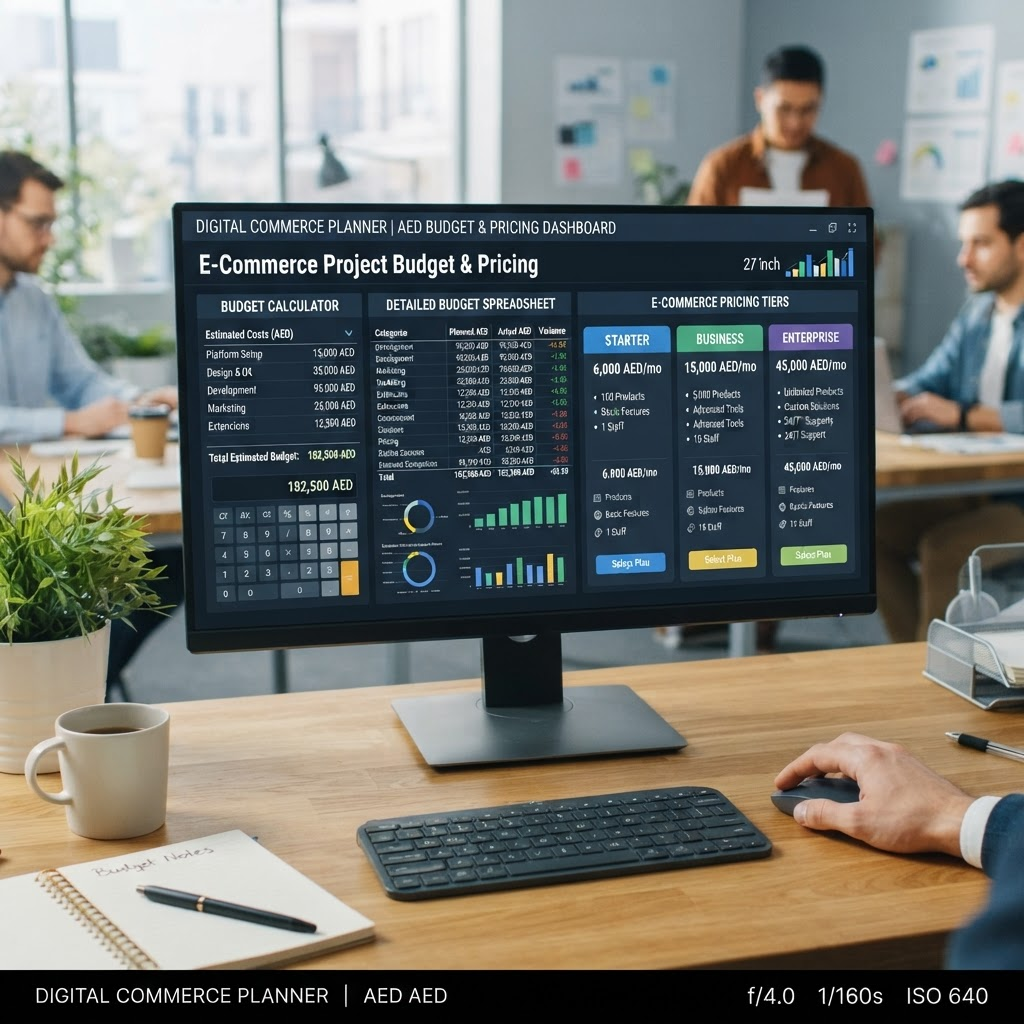
Example: Building a Budget for a UAE Online Store
Imagine a UAE retailer launching a homeware store with 120 products, Arabic and English content, a payment gateway, and nationwide delivery.
Rather than relying on an unverified headline price, the business can create a structured budget.
| Budget Item | How to Estimate It |
|---|---|
| Design and development | Project quotation based on functionality |
| Product entry | Product count and data readiness |
| Bilingual content | Required translation, writing and editing |
| Payments | Provider contract and applicable charges |
| Delivery setup | Shipping zones and required integrations |
| Hosting or platform | Appropriate plan and operational requirements |
| Maintenance | Required support and update arrangements |
| Marketing | Separate plan based on channels and objectives |
This approach makes the overall investment more transparent and helps prevent scope misunderstandings.
One-Time Costs vs Ongoing Ecommerce Expenses
The launch budget and operating budget should be assessed separately.
Possible ongoing expenses include domain renewals, platform subscriptions, hosting, paid extensions, payment transaction fees, maintenance, customer support systems, and marketing activities.
Physical-product retailers may also have fulfilment, storage, delivery, and returns expenses that change with order volume.
Not every store requires every cost category.
The important step is to identify which costs belong to the business and which are included in the development provider's agreement.
Ecommerce Business Requirements in the UAE
A technically functional store is not automatically ready to operate as a licensed business.
The UAE Government's official ecommerce guidance explains that online traders must meet the applicable licensing, regulatory, technical, consumer information, and data protection requirements.
The exact requirements depend on the emirate, business activity, licensing authority, and products or services offered.
Businesses should also review relevant taxation and invoicing obligations with qualified advisers where applicable.
Official reference: https://u.ae/en/information-and-services/business/ecommerce/
How to Control Ecommerce Development Costs
A practical way to control expenditure is to distinguish essential launch features from features that can be introduced later.
For example, a new retailer may start with a focused catalogue, clearly defined delivery areas, and standard platform functionality.
More advanced automation can be evaluated after the business understands its actual operational needs.
However, cost reductions should not compromise payment reliability, customer data protection, clear product information, or mobile usability.
The aim is to remove unnecessary complexity rather than weaken essential functionality.
How to Compare Ecommerce Development Proposals
Before selecting a provider, review the following:
1. Proposed platform and technology. 2. Product entry limits and responsibilities. 3. Mobile shopping experience. 4. Arabic and English requirements. 5. Payment integration deliverables. 6. Shipping and relevant tax configuration. 7. Inventory and accounting integrations. 8. Foundational technical SEO. 9. Domain, hosting, and account ownership. 10. Pre-launch checkout and order testing. 11. Support and maintenance terms. 12. Third-party and recurring fees.
Ask to review a complete purchase journey, from the product page to order confirmation, before accepting the finished project.
How Does SEO Affect Ecommerce Development Cost?
An ecommerce website needs a clear structure for products and categories.
Foundational SEO work may include page titles, category organization, internal linking, basic structured data where suitable, and control of unnecessary duplicate filter URLs.
Ongoing organic growth, however, may require additional content development, technical analysis, product optimization, and performance monitoring.
Businesses should distinguish the SEO setup included in development from any ongoing SEO service agreement.
Conclusion: Plan the Whole Ecommerce Investment
Ecommerce website costs in the UAE depend on the actual business requirements, not simply the name of the platform used to build the store.
The clearer the product catalogue, language requirements, payment methods, delivery workflow, and integrations, the easier it becomes to prepare a realistic quotation and operational budget.
Whether you are launching a new store or replacing an existing platform, Smart Screen DXB can discuss your project requirements and provide a scope-based development quotation.
CTA: Request an Ecommerce Website Quotation on WhatsApp.
FAQ
Frequently Asked Questions
How much does an ecommerce website cost in the UAE?
Costs depend on the platform, product catalogue, design, languages, payment and delivery integrations, and required functionality. A defined scope is needed for an accurate quotation.
Is Shopify cheaper than WooCommerce?
The answer depends on the project. Compare development expenses alongside subscriptions, hosting, plugins, integrations, and ongoing maintenance rather than initial pricing alone.
Does ecommerce development include payment gateway integration?
It depends on the agreement. The technical integration and the payment provider's commercial fees should be identified separately.
Can an online store support Arabic and English?
Yes. Product content, navigation, category pages, checkout text, metadata, and right-to-left layout requirements should be planned for both languages.
What is the difference between platform-based and custom ecommerce development?
A platform-based store uses existing commerce functionality, while custom development provides specialized workflows but generally involves greater engineering and maintenance responsibility.
Do I need a business licence to sell online in the UAE?
Online businesses must meet the licensing and approval requirements applicable to their activity and jurisdiction. Requirements vary by emirate, product category, and licensing authority.
What ongoing costs should I plan for?
Potential expenses include hosting or platform subscriptions, domain renewals, payment charges, extensions, maintenance, shipping, and marketing, depending on how the store operates.
Can I add more products after launch?
Yes, if the store's administration and catalogue structure support expansion. Product and inventory management requirements should be considered during planning.
Is SEO included in ecommerce website development?
Foundational technical SEO can be included in development. Ongoing content optimization, search performance analysis, and visibility improvement may be separate services.
What information should I provide for an ecommerce quotation?
Share your product types and quantities, target markets, languages, preferred payment and shipping arrangements, integrations, and any future features that may affect the store architecture.

Planning an ecommerce website in Dubai?
Discuss your store requirements with our team and request a tailored quotation.
Discuss on WhatsAppEcommerce development in DubaiSelected reading
Related Articles

E-Commerce Website Development: Build Your Online Store That Sells
Complete guide to building an e-commerce website that converts visitors into customers and generates consistent revenue.
Read article
E-Commerce Success Guide: Build a Profitable Online Store
Learn the complete strategy for building and scaling a profitable e-commerce business.
Read article
E-Commerce User Experience: Design for Higher Conversions
Master e-commerce UX design principles that reduce friction and increase sales.
Read article