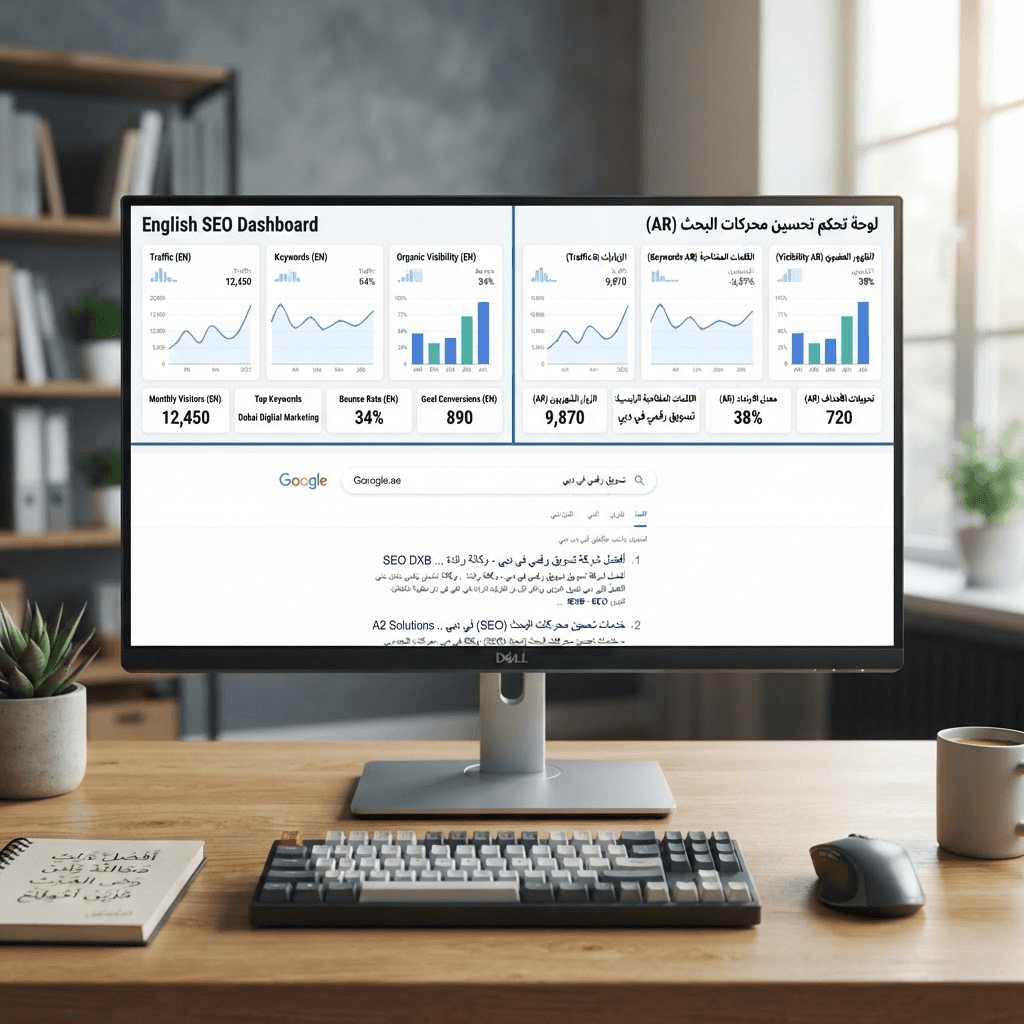
The UAE has a unique digital environment: a highly educated, bilingual population searching in both Arabic and English — often for the same products and services. A monolingual English website captures only a fraction of the available search demand. A properly implemented bilingual SEO strategy doubles your keyword coverage and reaches an entirely separate audience.
Why Arabic SEO Is a Separate Strategy, Not a Translation Arabic search behaviour differs significantly from English:
- Arabic keywords have different search volumes — a service that is searched 500 times/month in English may be searched 2,000 times/month in Arabic, or vice versa
- Arabic users often use different terminology, colloquialisms, and regional dialect variations
- Google indexes Arabic content independently from English content
- Competition in Arabic SERPs is often significantly lower than equivalent English SERPs
Simply translating your English content word-for-word misses the keyword nuances that drive Arabic traffic.
Technical Implementation: Getting Hreflang Right Hreflang tags tell Google which language version of each page to show to which audience. For a bilingual UAE website:
- English pages: hreflang="en-AE" (English, UAE)
- Arabic pages: hreflang="ar-AE" (Arabic, UAE)
- Each page should include hreflang links to its counterpart
- Self-referencing hreflang on each page variant
URL structures should be clearly separate: /en/ and /ar/ subdirectories, or ar.yourdomain.com subdomain.
Arabic Keyword Research Tools like Google Keyword Planner, Semrush, and Ahrefs support Arabic keyword data. Process: 1. Identify your primary English keywords 2. Do not simply translate — research independently using Arabic terms 3. Include Modern Standard Arabic (فصحى) AND Gulf colloquial terms where significant 4. Check search volume separately for .ae, Saudi Arabia, and broader GCC audiences 5. Identify uniquely Arabic search queries with no English equivalent
On-Page Arabic SEO
- Title tags and meta descriptions must be in Arabic for Arabic pages
- H1 and heading structure should use Arabic keywords naturally
- Alt text for all images should be provided in Arabic on Arabic pages
- Internal linking between Arabic pages should use Arabic anchor text
- URL slugs can be in English (Arabic slugs create encoding issues) but content must be fully Arabic
RTL Design Must Be Correct A technically correct Arabic website that renders poorly in RTL damages user experience and increases bounce rates — directly signalling to Google that the page does not satisfy Arabic searchers. Ensure RTL layout is tested across all devices.
Content Quality in Arabic Machine-translated Arabic content is recognisable to native speakers and ranks poorly. Professional Arabic content written by native speakers who understand your industry is the only viable approach for competitive rankings.

Related Articles

Local SEO UAE: Dominate Your Local Search Results
Master local SEO strategies to rank higher in Google searches and attract more customers in your area.
Read article
Google Ads Campaigns: Drive Qualified Traffic and Maximize ROI
Learn how to create and manage Google Ads campaigns that deliver measurable results and strong return on investment.
Read article
Content Strategy 2024: How to Create Content That Converts
Master the latest content marketing strategies to drive engagement, build authority, and increase conversions in 2024.
Read article